Personal tools
Home

UCLA Bioengineering top 10 in National Research Council Rankings

The UCLA PhD program in Biomedical Engineering was ranked in the top 10 of all programs across the country based on a recent evaluation by the independent National Research Council (NRC). Both survey-based and regression-based rankings placed UCLA BE in the top 10. More details on the rankings can be found at http://www.nap.edu/rdp/


COMING SOON

M.D./Ph.D. program in Bioengineering

STAR Ph.D. program in Bioengineering

More information will be available online soon.


Professor Gerard Wong Elected APS Fellow

wongaps2011Professor Gerard Wong was recently elected to be a Fellow of the American Physical Society. The American Physical Society, whose membership is dedicated to advancing the field of physics, is the second largest of its kind in the world, and is behind such publications as Physical Review and Physical Review Letters.

Read full article.


Professor Ozcan's LUCAS Named Top Innovation of 2011

ozcantopinnovator2011

Professor Aydogan Ozcan and his research group have been recognized by The Scientist magazine for their project, a Lenseless, Ultra-wide-field Cell monitoring Array platform based on Shadowimaging (LUCAS).

Read full article.


Professor Dino Di Carlo named Packard Fellow

dicarlopackardThe David and Lucile Packard Foundation has named Dino Di Carlo, assistant professor of bioengineering at the UCLA Henry Samueli School of Engineering and Applied Science, a 2011 recipient of a Packard Fellowship for Science and Engineering.  Di Carlo was among 16 recipients in this year’s class of Packard Fellows. 
Read full article.


For information on Dino Di Carlo’s research: http://biomicrofluidics.com/

For information on the David and Lucille Packard Foundation: http://www.packard.org


Cell penetrating peptides work like swiss army knife

cellpen

In a new study published in the Proceedings of the National Academy of Science, a team of UCLA Bioengineering researchers led by Gerard Wong showed how cell penetrating peptides (such as the HIV TAT peptide) can deliver cargo across cell membranes by multiplexing interactions with the membrane, the actin cytoskeleton, and specific cell-surface receptors. Moreover, because they now know how cell penetrating peptides work, it is now possible to have a general recipe for reprograming normal peptides into cell penetrating peptides. Other team members in this multidisciplinary collaboration include Profs Tim Deming and Dan Kamei from UCLA Bioengineering, and Prof. JJ Cheng from the University of Illinois at Urbana-Champaign. The lead authors of this work are Abhijit Mishra (now an Assistant Professor in IIT Ghandinagar in India) and Ghee Hwee Lai. More details can be found in the UCLA press release below.

http://newsroom.ucla.edu/portal/ucla/ucla-engineering-study-shows-how-216290.aspx


Professor Aydogan Ozcan receives the Presidential Early Career Awards for Scientists and Engineers (PECASE)

ozcanpecase2011PECASE is the highest honor bestowed by the US government on science and engineering professions in the early states of their independent research careers.

Click here to read full article


Antivirals inspired by the shark's immune system

sharkavimageNo one understands why sharks are such hardy animals. It turns out that they have an unusual immune system. A team from the UCLA bioengineering department led by Gerard Wong participated in a multi-national collaboration that identified a new broad spectrum systemic antiviral agent, squalamine, which is isolated from sharks. In tissue cultures, the compound inhibited the infection of blood vessel cells by the dengue virus, and human liver cells by the viruses for hepatitis B and D. Moreover, animal studies indicated that squalamine can control infections by the virus responsible for yellow fever, the eastern equine encephalitis virus, and the murine cytomegalovirus. Studies at UCLA and Northwestern showed that the antiviral effect likely came from an electrostatic remodeling of the membrane by squalamine, which can temporarily turn off endocytosis. The figure below shows that squalamine (pink) can displace Rac1 (blue), which is part of the cellular machinery for endocytosis, from membranes. The multi-institutional research team was led by Michael Zasloff from the Georgetown University Medical Center. This work was published in the Proceedings of the National Academy of Science in 2011, and has been covered extensively by the popular press, including the LA Times, BBC, and National Geographic. 


See press release articles below for full story

National Geographic
BBC

LA Times


Professor Andrea Kasko receives NIH Director's New Innovator Award

kaskonewinnovator

Andrea M. Kasko, assistant professor of bioengineering at the UCLA Henry Samueli School of Engineering and Applied Science, has received a 2011 NIH Director’s New Innovator Award from the National Institutes for Health (NIH). The NIH award program supports exceptionally creative investigators at an early stage in their career who have proposed highly innovative projects. These projects hold potential for a significant impact on an important biomedical or behavioral research problem. The research grant is for $1.5 million over five years.

Click here for full article by Matthew Chin


Professor Dino Di Carlo receives DARPA Young Faculty Award


darpadicarloDino Di Carlo, an assistant professor of bioengineering, was awarded a Young Faculty Award (YFA) from the Defense Advanced Research Projects Agency (DARPA).  The goal of the DARPA YFA program is to identify and engage rising research stars in junior faculty positions in academia and expose them to Department of Defense (DoD) needs and DARPA's program development process.  The long term goal is to develop the next generation of academic scientists, engineers, and mathematicians in key disciplines who will focus a significant portion of their career on DoD and national security issues.

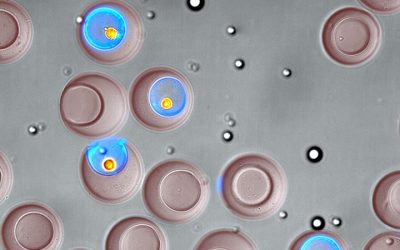
Specifically, Di Carlo’s project aims to monitor the immune state of an individual by examining shape changes in white blood cells when precisely squeezed.  A key challenge is developing an automated and miniaturized tool that can repeatedly deform and measure thousands of white blood cells in a short time.  The project leverages the strong ties between the Bioengineering Department and the David Geffen School of Medicine at UCLA to explore new territory for diagnosis of disease based on physical rather than molecular properties of cells.

Di Carlo has previously been awarded an NIH Young Investigator Award.  This year, DARPA awarded 39 young faculty awards. UCLA had two recipients of the award this year: Di Carlo, and Anastassia Alexandrova, a UCLA assistant professor of chemistry and biochemistry.

http://www.darpa.mil/Opportunities/Universities/Young_Faculty.aspx

More information on the research in Di Carlo’s Laboratory can be found at www.biomicrofluidics.com 


Accessible and Affordable Care at Heart of Healthcare Technology Grants

lucasozcanFive teams of scientists from multiple campuses of the University of California and a Southern California hospital have been awarded up to $100,000 each to commercialize their ideas for new, lower cost health care technologies that will address a long-standing need for more affordable and efficient chronic disease management and preventive health care, particularly in underserved communities.  Professor Aydogan Ozcan is one of the five teams of scientists to receive this award for his research on microscopy on a cell-phone as a diagnostic tool (LUCAS).  More information can be found at:

UCLA HSSEAS News

BBC News

Professor Ozcan recently received the Army Research Office (ARO) Young Investigator Award and the Regional Health Care Innovation Award from The von Liebig Center at USCD.


"UCLA study shows bacteria use Batman-like grappling hooks to "slingshot' on surfaces"

 webbacteriaBacteria use various appendages to move across surfaces in order to form multicellular bacterial biofilms, which are communities of cells responsible for lethal persistent infections and failure of many biomedical devices. One textbook example of this is "twitching" motility, which is made possible by hairlike structures on their surface called type IV pili, or TFP. A research team from the Gerard Wong group at UCLA Bioengineering has found that bacteria not only can use TFP like batman’s grappling hooks to pull themselves along a surface, they can use TFP as a slingshot to propel themselves. Dr. Fan Jin, now a Professor at the University of Science & Technology of China (USTC), and Dr. Jacinta Conrad, now a Professor at the University of Houston, are the lead authors of this work, which was published in the Proceedings of the National Academy of Sciences. Additional details are in the following press release.  

http://newsroom.ucla.edu/portal/ucla/ucla-engineering-researchers-discover-210547.aspx


 _______________________________________________________________


 Dicarlo_LOC_Coverexplosion_dicarlo


Document Actions